
How to Find a Cheaper Flight Ticket
It’s the key step when planning any trip — and one that can save you a lot of money and time.
There are a few small tricks that make a big difference, and I’ll break them down for you in this article.



Which flight comparison site should you use?
There are plenty of efficient flight comparison tools out there — like Kayak, Skyscanner, or Liligo.
My personal favorite is Momondo. It’s simple, intuitive, and packed with useful filters — easily one of the best tools to find cheap flights that fit your needs.
That doesn’t mean you should ignore the others.
Each platform has its strengths, and sometimes a flight appears on one but not the others.
That’s why I always double-check across multiple sites before booking.
It often helps me find the lowest available fare.
In the rest of this guide, I’ll show you my method for searching and booking flights, plus a few easy ways to save both time and money.

Steps for Finding the Best Flight Deals
Finding a cheap flight isn’t just about luck. Behind every comparison site are powerful algorithms designed to spot huge price differences in seconds. If you stay flexible with your travel dates or departure airports, these tools can truly make a difference. The key is learning how to use them smartly — that’s how you unlock the best fares.
Here’s exactly how I do it.
Step 1 : Choose Your Departure and Arrival Airports
Start by defining your departure and arrival airports — this simple decision can already impact the final price of your flight. Flying from a major hub like Paris–Charles de Gaulle is often cheaper than from a smaller regional airport. The more airlines compete on the same route, the more prices tend to drop.
 Pro Tip : If you’re flexible, activate the “Nearby Airports” option on Momondo or Skyscanner. These platforms automatically check departures and arrivals from nearby cities — and that’s often where the best deals hide. You can sometimes save a lot by flying from a neighboring airport. The same logic works for arrivals: land in a nearby city, then finish your journey by train or bus. Even with the transfer, the total cost usually ends up lower than a direct flight.
ChatGPT a dit :
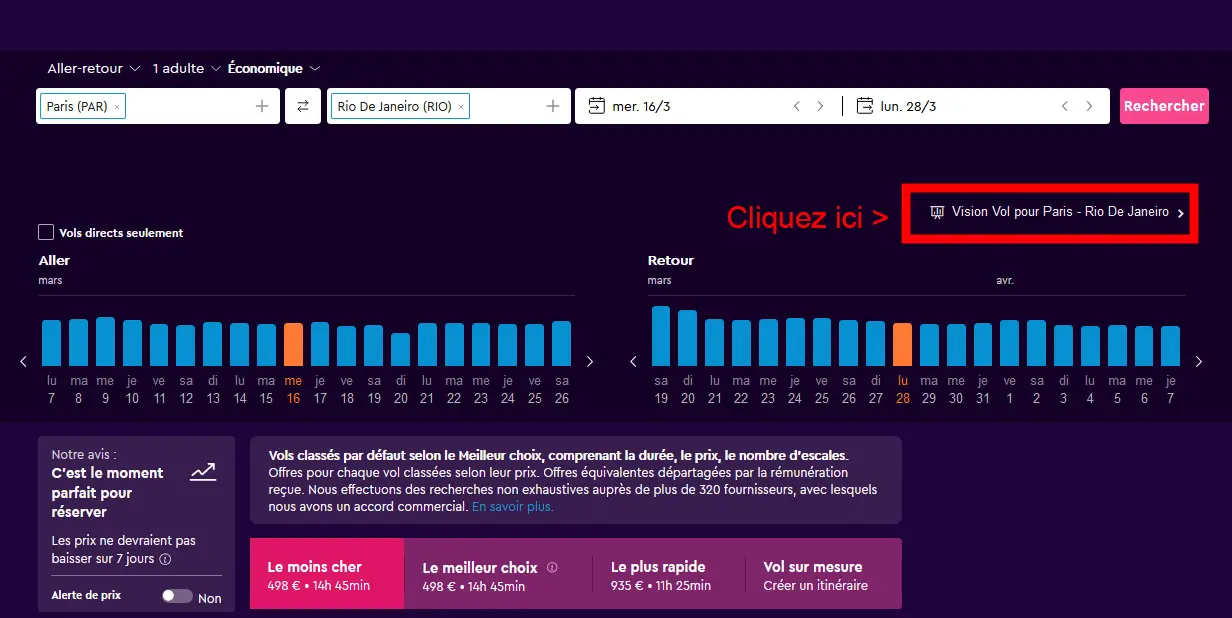
Now you can see how many factors influence a plane ticket’s price — your travel dates, the day of the depart, the time of the day, the airline, the route even how many days in advance you book
Each variable can shift the price dramatically.
It’s a complex puzzle — and finding the perfect deal often takes more than just luck.

These charts aren’t an exact science, but they can be incredibly useful.
They’ve often helped me spot patterns and plan smarter when organizing a trip.
Think of them as guidelines, not guarantees — a way to make informed choices rather than relying on pure luck.
Pro tip : Check this view for every single route.
What works for one trip doesn’t always apply to another.
All these data points — destination, timing, even season — shift constantly.
Comparing systematically helps you dodge bad surprises and uncover the real hidden deals.
Step 3: Use the right search filters
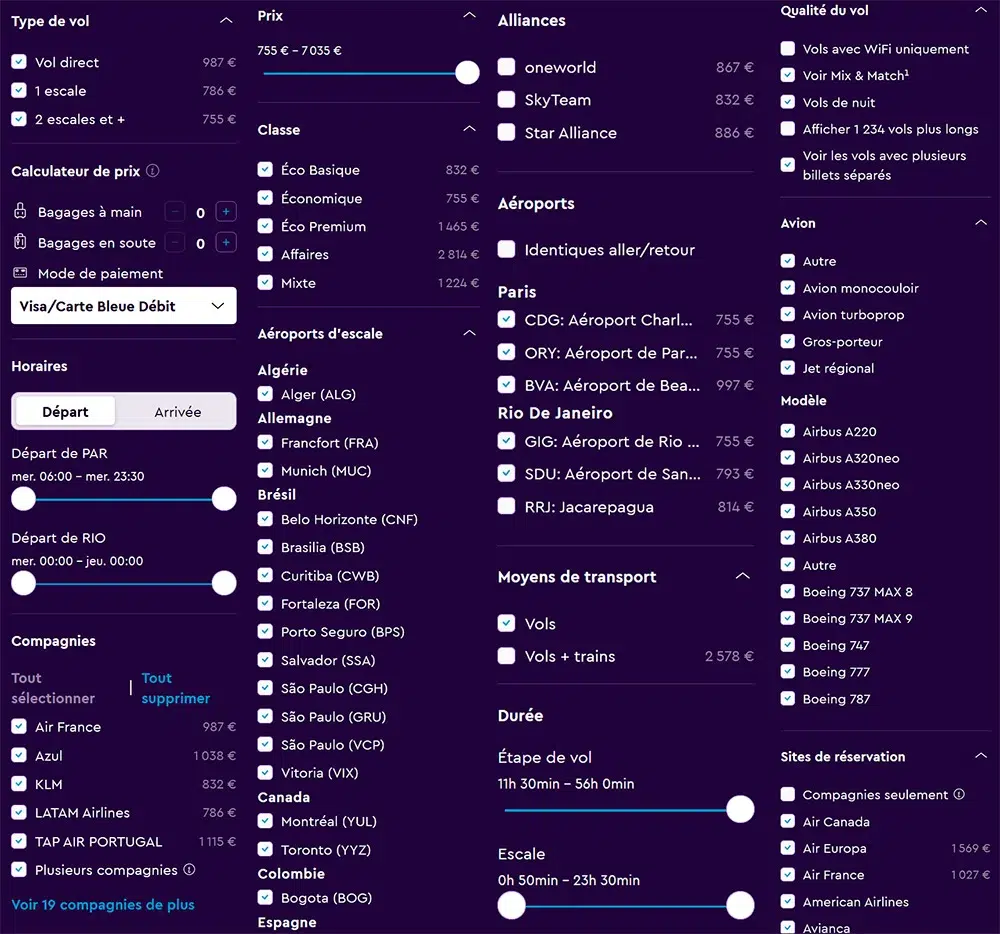
Flight search filters are your best friends — they save both time and money.
Once your departure airports and travel dates are set, refine your search like a pro:
-
Number of stopovers:
A flight with one stop is often cheaper than a nonstop route.
I usually tick “1 stop” when my goal is to get the lowest price. -
Airlines:
Compare budget and regular airlines side by side.
Low-cost carriers often undercut prices, but always double-check for hidden fees. -
Total travel time:
Avoid long layovers that leave you drained before you even arrive.
I usually set my max layover time to around 5 hours — the perfect balance between price and comfort.
Step 4: Run your search and explore the results
Once your settings are ready, launch the search.
Most flight comparison tools automatically sort results into three key categories: Best price, fastest route, and best overall deal.
Start with those — they’ll help you narrow things down quickly.
Then, pick the option that fits your needs and open the “Flight Details” tab.
Check the route, fees, and baggage policy carefully before booking.
For example, on a Paris → Rio search, I always start by checking “Best deal” before comparing other options — it saves time and avoids hidden surprises.
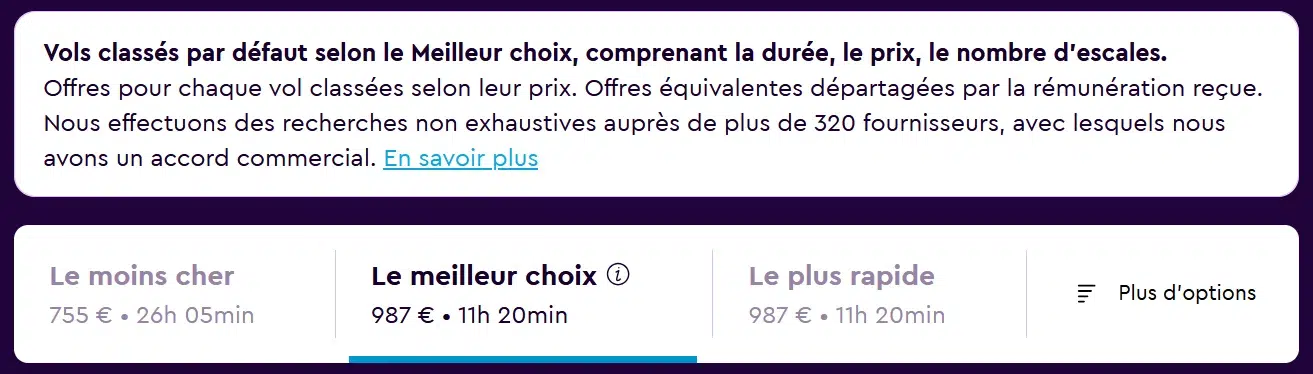
Pro tip : Never trust the very first flight result you see.
Some comparison sites highlight partnered offers rather than the true best deal.
Take a few seconds to scroll through a couple of alternatives — comparing just two or three options can often save you tens of euros (or dollars).
Step 5 : Catch the best deals with price alerts
When you find a flight you like but aren’t ready to book, set up a price alert.
You’ll get an email whenever the fare drops — or rises.
I personally use Kayak and Momondo, especially when planning trips several months ahead.
It’s one of the best ways to avoid overpaying and spot hidden fare drops before they disappear.
Create 2–3 alerts — for nearby dates and alternate airports.
That way, you multiply your chances of catching a truly cheap flight.
Step 6: Pick a flight that fits your schedule and budget
Momondo’s algorithm ranks flights by price and total travel time — a great starting point.
I always aim for balance: a fair price, a reasonable journey length, and manageable flight times.
Flying very early or landing late often lowers the cost, but it still has to fit your schedule.
A cheap flight that disrupts your whole trip isn’t really a bargain.
Quick checklist before booking:
-
Total travel time and layover duration
-
Whether baggage is included
-
How convenient the arrival airport is for local transport
Pro tip : Accepting a little less comfort can sometimes mean a much lower fare.
On long-haul flights, a longer layover often cuts the total cost significantly.
You can easily make it work — sleep at the airport, book a capsule hotel, or relax in an overnight lounge.
Just double-check baggage fees and terminal safety before committing to the deal.
Step 7: Final check — confirm directly on the airline’s website
Once you’ve found your flight, double-check the fare directly on the airline’s own site.
The price is often slightly lower there — no third-party commission, and sometimes exclusive member deals.
Another big advantage: customer service is smoother.
You can manage your booking, check-in, and seat selection without intermediaries.
If schedules change, airlines usually handle it faster than booking platforms do.
Always compare the final total, including baggage and payment fees.
Some OTAs sneak in extra charges at checkout, while others offer promo codes that make them cheaper.
Decide based on the true final price, not just what you see on the first screen.
Air France? Emirates? Picking the Right Airline
There’s no universal rule here — your choice depends entirely on your travel style and priorities.
Forget the clichés: the cheapest flight isn’t always the smartest one.
A backpacker, for instance, doesn’t necessarily benefit from the lowest fare available.
Three long stopovers can easily turn a bargain into a nightmare.
Adaptability is key — what works for one traveler might not fit another.
Decide based on what matters most to you:
-
Budget and hidden fees
-
Tolerance for layovers and total travel time
-
Flight times and convenient airports
-
Onboard service and included baggage
-
Punctuality, safety, and airline network
-
Miles and loyalty status
1) Low-Cost vs. Full-Service Airlines
Low-cost carriers — like Ryanair, EasyJet, AirAsia, or Wizz Air — dominate the short-haul market.
Their base prices are extremely attractive, but beware: extra fees add up fast.
Additional costs to factor in before buying:
-
Cabin or checked baggage: often charged separately.
-
Seat selection: rarely included in the base fare.
-
Food and drinks: almost always paid extras.
-
Airport check-in: sometimes comes with a fee (looking at you, Ryanair).
Baggage rules:
Budget airlines are strict — weight and size limits are enforced, and penalties can be steep.
Always double-check what’s included before finalizing your booking.
Pro tip : Always calculate the total price — including every extra fee.
That “cheap” ticket can easily end up costing as much as (or more than) a full-service airline once you add luggage, seat selection, and other hidden costs.
Pro tip : Full-service airlines sometimes launch promotions that make them just as affordable as low-cost carriers.
Watch for seasonal sales or low-demand periods — that’s when the best deals usually appear.
Booking during these windows can score you premium comfort for a budget price.
3) Loyalty Programs and Air Miles
Full-service airlines are usually part of global alliances like SkyTeam, Star Alliance, or Oneworld.
Even in economy class, every flight you take earns miles — and those miles add up faster than you think.
Earning miles
Sign up if you often fly with the same alliance.
For example, Flying Blue (Air France / KLM) lets you collect miles not just from flights, but also from purchases made through partner brands.
Credit cards
Some credit cards offer transferable points that can be converted into miles.
They’re perfect for getting discounts, upgrades, or even free reward tickets once your balance grows.
Pro tip: Some credit card programs also let you earn miles on everyday purchases, which can then be transferred to your favorite airlines.
If you travel often, this strategy helps you reach rewards and discounts much faster — sometimes without even flying.
4) Match Your Airline Choice to Your Travel Style
Backpacker / Tight Budget
Traveling light with flexible dates? Low-cost airlines are fine — just plan ahead for hidden fees.
Baggage, seat selection, and food add up quickly if you’re not careful.
Business Travel / Need Flexibility
Here, comfort and adaptability come first.
Look into Air France, British Airways, or Lufthansa for modifiable tickets, airport lounges, and smoother boarding — the peace of mind is worth it.
Long-Haul Flights
Quality matters more when you’re in the air for 10+ hours.
Emirates, Qatar Airways, and Singapore Airlines excel in service — seats, meals, and entertainment all make a real difference to your experience.
5) Getting the Most Out of Full-Service Airlines
Upgrades
Watch for upgrade offers at the airport or through your miles program.
Sometimes, the price difference is surprisingly reasonable — and totally worth it.
Seat Selection
Plan ahead on long-haul flights.
Front rows = faster exit.
Exit rows = more legroom (but often for a small fee).
Arrive Early
It gives you better seat choices and less stress.
And occasionally, if the cabin is full, you might even get a free upgrade.
6) In Summary — Your Priorities Decide
The low-cost vs full-service debate isn’t just about price.
Your priorities — budget, comfort, flexibility, and service — are what truly matter.
- Short flight with minimal luggage: low-cost usually wins
- Long-haul trip: the comfort of a full-service airline is worth paying for.
- Flexible dates or schedule changes: full-service is the safer bet.
For example : On my last trip from Paris to Dubai, I chose Emirates for the quality of service on board — even though the ticket was slightly more expensive than some low-cost options with stopovers.
For me, the non-stop flight, included meals and baggage, and great entertainment easily justified the extra cost.
That’s exactly why it’s so important to match your airline choice to your own needs and travel style — not just the price tag.
In Conclusion
At the end of the day, there’s no magic formula for finding cheap flights.
It all comes down to timing — being in the right place, checking at the right moment, and staying consistent.
These small habits, applied with a bit of patience, can save you valuable money that’s far better spent once you arrive at your destination.
So, try out these tips, experiment with what works best for you, and enjoy the process.
Because every euro saved on your ticket is one more to spend on memories that actually matter.